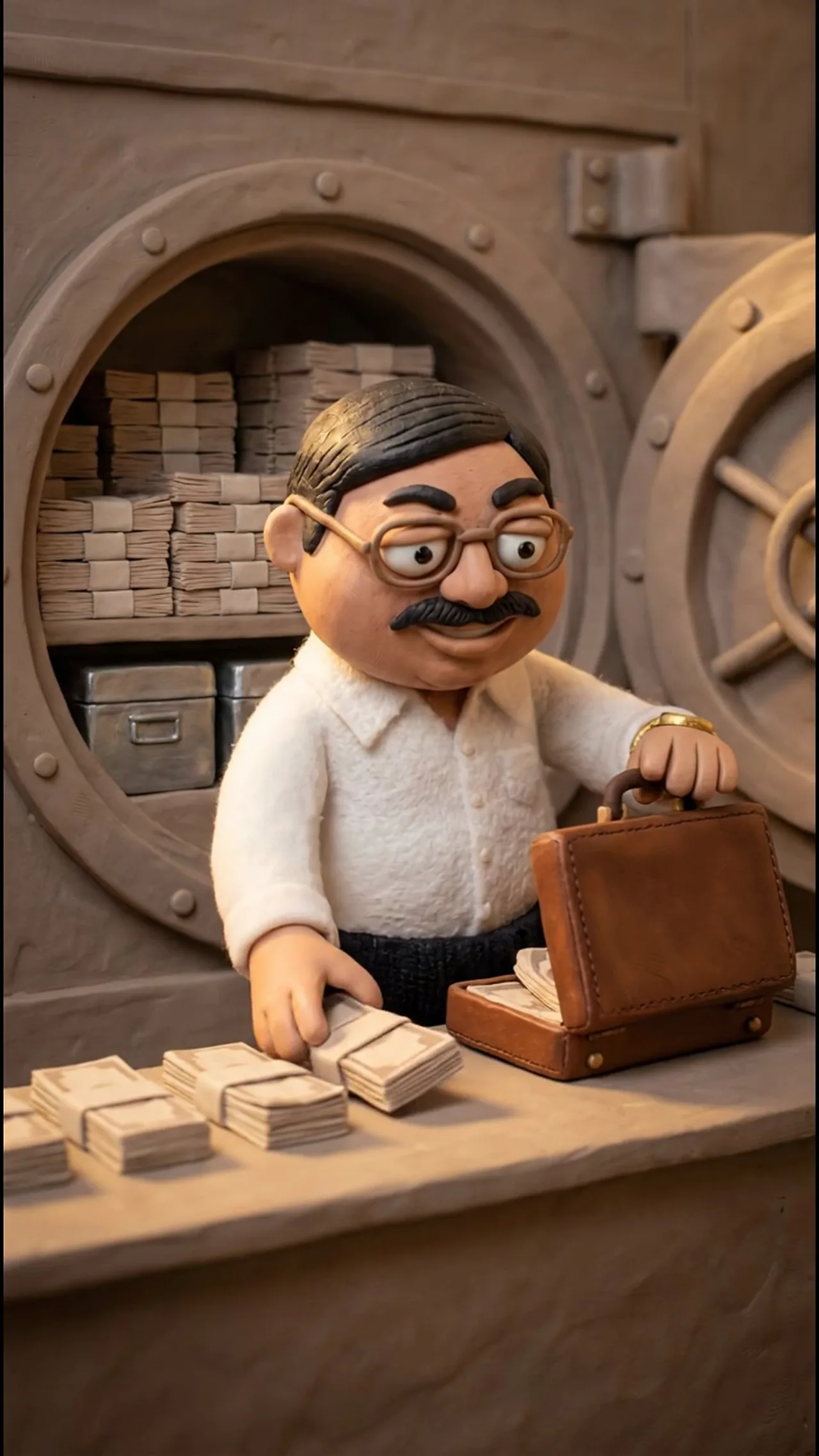
In 1992 India's banks discovered that a large part of what they held as government securities was paper: receipts promising bonds that did not exist. The broker at the center of it was Harshad Mehta, the "Big Bull" of the Bombay Stock Exchange. The lesson for KYB analysts: a document is a claim, and it has to be checked against a record the counterparty does not control.
What really happened
The man. Harshad Mehta was born in 1954 and grew up partly in Raipur. After a commerce degree in Mumbai he worked a string of jobs, which ThePrint lists as cement contractor, hosiery seller, insurance clerk and diamond sorter, before becoming a jobber and getting a broking license in 1984. In March 1992, India Today reported, he paid Rs 26 crore in advance income tax, the most of any individual in India; he showed photographers his 15,000 sq ft home on Worli Seaface. The Guardian's obituary mentions a fleet of cars that included a Lexus.
The market plumbing. Indian banks lent to each other through "ready forward" (RF) deals: short loans secured by government securities. In their IIM Ahmedabad analysis, Samir Barua and Jayanth Varma explain that banks rarely delivered the securities. The borrowing bank handed over a bank receipt (BR) instead, which confirmed the sale, acknowledged the money, and promised that the seller held the securities in trust for the buyer. In their words, the BR was "something like an IOU (I owe you securities!)". The Indian Banks' Association had rules for BRs (security paper, serial numbers, registered signatories), but Barua and Varma report that "none of these rules were seriously adhered to."
The scheme. Brokers in the middle of these deals routed bank cheques into their own accounts, then used BRs with nothing behind them. Brokers persuaded two small banks, the Bank of Karad and the Metropolitan Co-operative Bank, to issue BRs on demand, and large banks lent against them. By Barua and Varma's reading, fake BRs account for a little more than half of the total amount of the scam. The money went into shares. The Sensex ran from 1,194 to 4,467 between April 1991 and April 1992, a 274% rise, according to Forbes India. ACC, the cement maker, was among Mehta's best-known holdings.
The collapse. The first press reports appeared in April 1992, when the State Bank of India reported a shortfall in its government securities. Journalist Sucheta Dalal is credited with breaking the story (Forbes India, ThePrint). India Today reported that the Sensex fell a record 1,077 points between 26 April, when news of Mehta-related illegalities at SBI became public, and 13 May. The CBI arrested Mehta on November 9, 1992.
The size. Barua and Varma, working from the RBI's Janakiraman Committee, put the banking system's exposure at Rs 3,542 crore, of which about Rs 1,567 crore was attributed to Mehta, mostly as loans with no security at all. The fake Bank of Karad and Metropolitan BRs they tie to other brokers, including A.D. Narottam and Hiten Dalal. The Times of India, reporting the Supreme Court's 2003 ruling, said the committee's first report quantified the scam at Rs 4,300 crore. The Guardian cites about 50 billion rupees (Rs 5,000 crore).
The end. SEBI permanently barred Mehta from dealing in securities on April 19, 2001, in a separate 1998 manipulation case. He died on December 31, 2001, aged 47, in judicial custody at Thane, apparently of a heart attack. In January 2003 the Supreme Court upheld, 2 to 1, his conviction in a case about diverting Maruti Udyog funds. Mehta was already dead and had been awaiting the hearing of his appeal.
Where the film simplifies. The film credits Mehta with the small-bank receipts. The Janakiraman figures as Barua and Varma present them tie those fake BRs mainly to other brokers, and describe Mehta's own share as largely unsecured lending. The film's ACC figures ("two hundred rupees to nearly nine thousand, in three months") are widely repeated, but no contemporary source we fetched confirms them. India Today in May 1992 wrote only that he found ACC "below Rs 1,000" and projected it could "cross Rs 9,000". The film credits Dalal's story to April 1992. What we could confirm is that the first reports appeared that April and that she is credited with breaking the story.
The film
An 80-second clay-animated dramatization, published September 28, 2026. Characters and scenes are illustrations, not reconstructions.
Narration transcript
In 1992, a man in Bombay borrowed a fortune from India's biggest banks. All he gave them was a piece of paper. His name was Harshad Mehta. Before the stock market, he sold cement and sorted diamonds. Banks traded government bonds with each other. But the bonds rarely moved. The seller just handed over a receipt, a promise the bonds existed. Mehta found small banks willing to issue those receipts, with nothing behind them. The big banks took his paper, and handed him real money. He poured it into the stock market. A cement company's share went from two hundred rupees to nearly nine thousand, in three months. They called him the Big Bull. He drove a Lexus and lived in a sea-facing penthouse in Worli. Then a journalist named Sucheta Dalal started asking where the money came from. In April 1992, she published the story. The market crashed. The banks went looking for the bonds behind their receipts. There were none. The hole was estimated at around five thousand crore rupees. Mehta died in custody in 2001. He was forty-seven. Every bank had a receipt. Stamped, signed, perfectly normal. Not one of them checked what was behind it. Today, the receipt is a bank statement, an invoice, a certificate. It still looks perfectly normal. At Sweat AI, we check what's behind the paper. The registry, the account, the real owner. A receipt is only as good as what's behind it. Sweat AI. Let us sweat for you.
How KYB would have caught it
The banks had documents. They lacked a check of each document against an independent record, the same gap onboarding teams face when a bank statement or certificate is taken as proof of what it describes.
| Red flag | What a KYB or fraud analyst checks | Evidence that would have surfaced |
|---|---|---|
| A receipt stands in for the asset itself | Confirm the asset at the custodian of record, not from the counterparty's paper: for government securities, the RBI Public Debt Office's SGL ledger | The issuing bank's SGL balance would not cover the receipts in circulation |
| Receipts far larger than the issuer could plausibly back | Compare the exposure with the issuer's size and set a counterparty limit | Barua and Varma suggest Rs 50 lakh as a reasonable limit for the Bank of Karad, against RF deals for hundreds of crores |
| Money for one bank lands in a broker's account | Match the named payee and beneficiary account with the counterparty in the contract | Account-payee cheques to banks credited to brokers' personal accounts |
| Documents that ignore their own issuing rules | Check format against the published standard: serial numbers, security paper, registered signatories | BRs issued outside the IBA rules, a sign that nobody was reconciling them |
| A customer's visible wealth outruns any explained source | Source of funds and source of wealth review, plus adverse media screening | Unexplained scale of trading and rapid public prominence before April 1992 |
| One intermediary on both sides of many trades | Map related parties and control persons across counterparties | A small group of brokers linked to the same small issuing banks |
Related terms
- Evidence packet
- Business verification documents
- Source of funds vs source of wealth
- Adverse media screening
- Control person
- Four-eyes review
See also how to verify a business for KYB.
Sweat AI is an AI-native BPO for banks and fintechs, starting with back-office workflows like KYB, onboarding and fraud reviews. Our analysts check each document against sources the applicant does not control, nights and weekends, and deliver the review, the evidence and a recommendation. Your team makes the final decision. See KYB review or fraud alert review.
Questions
What was a bank receipt (BR) in the 1992 Indian securities scam?
A bank receipt was a document one bank gave another in a ready forward deal instead of delivering the government securities. It confirmed the sale and promised the securities were held in trust for the buyer. A fake BR had no securities behind it, so the lending bank was in fact making an unsecured loan.
How much money was involved in the Harshad Mehta scam?
Estimates differ. The IIM Ahmedabad analysis of the RBI's Janakiraman Committee figures puts the banking system's exposure at Rs 3,542 crore, the Times of India reported the committee's first report at Rs 4,300 crore, and the Guardian's obituary of Mehta cites about 50 billion rupees (Rs 5,000 crore).
How did Harshad Mehta die?
He died on December 31, 2001, aged 47, in judicial custody at Thane, apparently of a heart attack, while cases against him were still pending.
Sources
- Barua and Varma, Securities Scam: Genesis, Mechanics and Impact (IIM Ahmedabad working paper, 1992; Vikalpa, 1993), archived copy, accessed 2026-09-30
- The Guardian, Obituary: Harshad Mehta (January 15, 2002), accessed 2026-09-30
- India Today, Securities scam: Harshad Mehta throws banking system, stock-markets into turmoil (May 31, 1992), accessed 2026-09-30
- India Today, Securities scandal: Investigators haul in more people (July 15, 1992), accessed 2026-09-30
- ThePrint, Scapegoat or mastermind of 1992 scam: Harshad Mehta's fall from grace, accessed 2026-09-30
- Forbes India, Economic Milestone: Stock Market Scam (1992), accessed 2026-09-30
- Times of India, SC upholds Harshad Mehta's conviction (January 14, 2003), accessed 2026-09-30
- SEBI press release PR 71/2001, Action against Harshad Mehta, Videocon, BPL and Sterlite (April 19, 2001), accessed 2026-09-30
- Economic Times (PTI), Harshad Mehta cremated (December 31, 2001), archived copy, accessed 2026-09-30