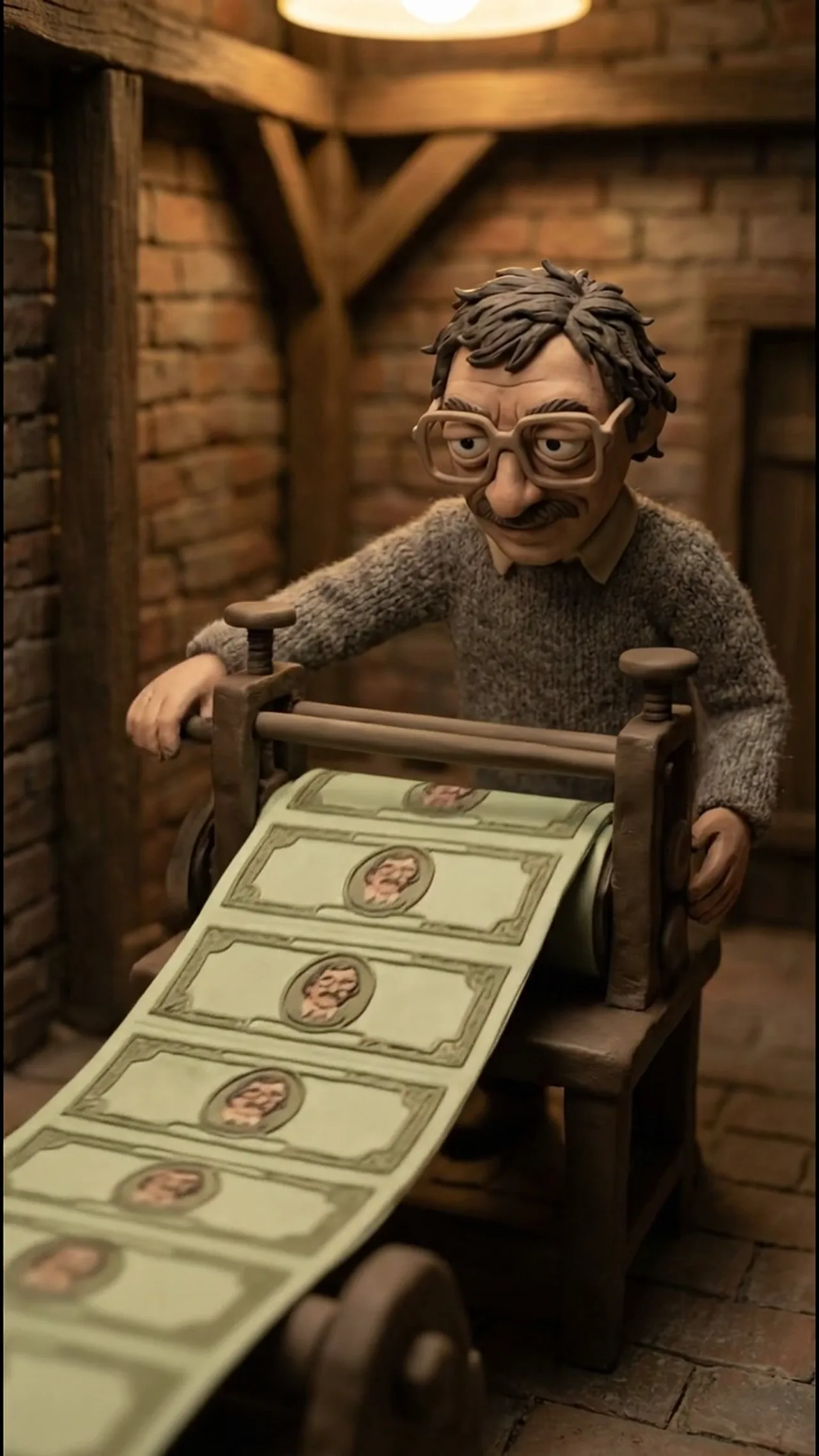
In 1994 a Moscow company called MMM sold paper that looked like Russian banknotes, carried its founder's portrait, and rose in price every few days because the founder said so. Millions of people bought it. This Fraud Files episode tells the story of Sergei Mavrodi in clay, then looks at it the way a KYB or fraud analyst would: what could have been checked, and where the evidence was.
What really happened
The company. Sergei Mavrodi founded MMM in 1989; TASS dates the company's existence from 1989 to 1994. According to RIA Novosti, MMM first issued shares and then, to get around legal limits on how much stock it could issue, began selling "MMM tickets." RIA describes them as painted paper that resembled Russian currency, "only with portraits of Mavrodi," at a face value of 1,000 rubles.
The price. The price was set by the company, not by a market. The Los Angeles Times reported that a share rose from 1,000 rubles in February 1994 to 125,000 rubles in July. UPI gave an initial offering price of 1,600 rubles and the same 125,000-ruble peak. Government investigators, as the Los Angeles Times reported, called MMM "a classic pyramid scheme that used income from new investors to buy back shares from old investors at ever-rising prices." The company promised annual returns of 3,000%.
The advertising. MMM ran a heavy television campaign. RIA Novosti counts 16 ads following an ordinary worker, Lyonya Golubkov, who invests in MMM and uses the returns to buy his wife boots, then a fur coat, and finally a car and a house. The Los Angeles Times described the ads as "slick, fictional," showing poor Russians cashing in shares to buy apartments in Paris.
The collapse. In late July 1994 the state moved in. The Christian Science Monitor reported that tax police announced MMM owed more than $24 million in taxes and fines, and that the Finance Ministry listed MMM among firms issuing illegal unregistered securities. Thousands of people converged on MMM's offices. UPI reported that MMM cut the share price from 125,000 rubles to 950 rubles and suspended trading. The Monitor wrote that MMM "boasts five to 10 million shareholders"; UPI cited an estimate of 5 million, with Mavrodi claiming double that. RIA Novosti later put the number of people harmed at about ten million.
The arrest and the election. Mavrodi was arrested on August 4, 1994, on charges that another of his companies had evaded taxes and that he was obstructing the investigation (Los Angeles Times; UPI reported he was held in Moscow's Matrosskaya Tishina prison). He was freed on October 12 and ran in a special election for a vacant Duma seat in a district north of Moscow, where the Los Angeles Times estimated 36,000 of the 489,000 voters were MMM investors. He told them his election and immunity from prosecution would be their best hope of recovering the value of their shares. He won with 27.8% of the vote. In October 1995 the Duma stripped him of his immunity (Los Angeles Times).
The conviction. MMM was declared bankrupt in 1997 and Mavrodi was placed on the wanted list (RIA Novosti). He was arrested in Moscow with a forged passport in January 2003, and in April 2007 a court found him guilty of fraud and sentenced him to 4.5 years (TASS). He died in a Moscow hospital on March 26, 2018.
Where the film compresses the record. The film says Mavrodi ran for parliament "from his cell." The Los Angeles Times reports he was released from jail on October 12, about two weeks before the vote, so he campaigned as a free man under a court order not to leave Moscow. The film calls Lyonya Golubkov an excavator driver; the sources above describe him only as an ordinary worker. The film's line that "the money was never found" is its own summary; we found no source that quantifies what was recovered.
The film
A claymation dramatization, about 78 seconds. Characters and scenes are illustrations, not likenesses.
Narration transcript
In 1994, a man in Moscow printed his own money. With his own face on it. Millions of people bought it anyway. His name was Sergei Mavrodi, and his company, MMM, sold shares that only ever went up. On TV, a humble excavator driver named Lyonya bought shares, and got richer in every ad. Every few days, a new price went up on the board. Higher. Always higher. But who set that price? Mavrodi did. Personally. It was not tied to anything. In a few months, one share went from under two thousand rubles to more than a hundred thousand. Then, in July, the line fell off the board. Five to ten million people lost their savings. Crowds surrounded the office, demanding their money back. And here is the strangest part. From his cell, Mavrodi ran for parliament. And his investors voted for him. They hoped a man in parliament could pay them back. He won. The seat came with immunity from prosecution. The money was never found. Everyone had proof that MMM was real. The ads. The tickets. The price. But every piece of that proof came from the same man. It still works that way. The statement, the website, the glowing reviews, all made by the person asking for your money. At Sweat AI, we check the proof against sources the seller does not control. Registries, filings, the real owners. If he prints the proof, it isn't proof. Sweat AI. Let us sweat for you.
How KYB would have caught it
MMM's weakness was that every piece of evidence an investor saw came from MMM. A KYB review works the other way: each claim gets tested against a source the applicant does not control.
| Red flag | What a KYB or fraud analyst checks | Evidence that would have surfaced |
|---|---|---|
| A price that only goes up, set by the issuer | Is there an independent market, custodian or valuation for the instrument? Who publishes the price? | The price came from MMM itself; UPI called it a "company-set share price" |
| Instruments that look like money but aren't registered | Securities regulator or finance ministry register for the issue | The Finance Ministry listed MMM among firms issuing illegal unregistered securities |
| Returns far beyond any real business (3,000% a year) | Source of funds: which revenue pays these returns? Compare to filed accounts | Investigators found returns paid from new investors' money |
| Marketing standing in for evidence | Treat ads, testimonials and websites as claims, then look for third-party confirmation | The flagship "customer" was a fictional TV character |
| Tax enforcement against a related company | Adverse media and public enforcement notices across the whole group, not only the applicant entity | Tax police claims of more than $24 million in taxes and fines, reported in July 1994 |
| Founder newly holding public office | Politically exposed person screening, with enhanced due diligence on source of wealth | Mavrodi won a Duma seat in October 1994 while under investigation |
None of these checks needs hindsight. Each uses a registry, filing, enforcement record or news report that existed at the time.
Related terms
- Politically exposed person (PEP)
- Adverse media screening
- Source of funds vs source of wealth
- Enhanced due diligence
- Evidence packet
For another scheme that paid old investors with new money, see Charles Ponzi. The full series is in Fraud Files.
Sweat AI is an AI-native BPO for banks and fintechs, and onboarding and fraud queues are where we start. When an application arrives with statements, websites and reviews that all trace back to the applicant, our analysts check each claim against registries, filings and independent sources, and prepare the review, the evidence and a recommendation. Your team makes the decision. See how a KYB review works, or ask us about a business investigation.
Questions
Who was Sergei Mavrodi?
Sergei Mavrodi founded MMM, the Moscow company behind Russia's largest pyramid scheme of the 1990s. MMM collapsed in July 1994, he won a Duma seat that October, and a Moscow court convicted him of fraud in April 2007 with a sentence of 4.5 years.
How many people lost money in MMM?
Contemporary reporting put MMM's shareholders at five to ten million. UPI reported an estimate of about 5 million, with Mavrodi claiming double that; RIA Novosti later put the number of people harmed at about ten million.
Why did the MMM share price only go up?
The company set the price itself. Government investigators, as reported by the Los Angeles Times, described MMM as a pyramid that used money from new investors to buy back shares from earlier ones at ever-rising prices.
Sources
- Russia watches pyramid scheme teeter (UPI, July 30, 1994), accessed 2026-09-30
- Russian pyramid victims hit government (UPI, August 28, 1994), accessed 2026-09-30
- Christian Science Monitor, July 28, 1994, on the MMM collapse, accessed 2026-09-30
- Russian Wins Parliament Seat and Immunity (Los Angeles Times, November 1, 1994), accessed 2026-09-30
- Los Angeles Times, October 26, 1995 (Mavrodi stripped of immunity), accessed 2026-09-30
- Sergei Mavrodi, 90s Ponzi scheme mastermind, dies in Moscow hospital (TASS, March 26, 2018), accessed 2026-09-30
- "Мы можем многое". Что обещал россиянам Сергей Мавроди (RIA Novosti, March 26, 2018), accessed 2026-09-30