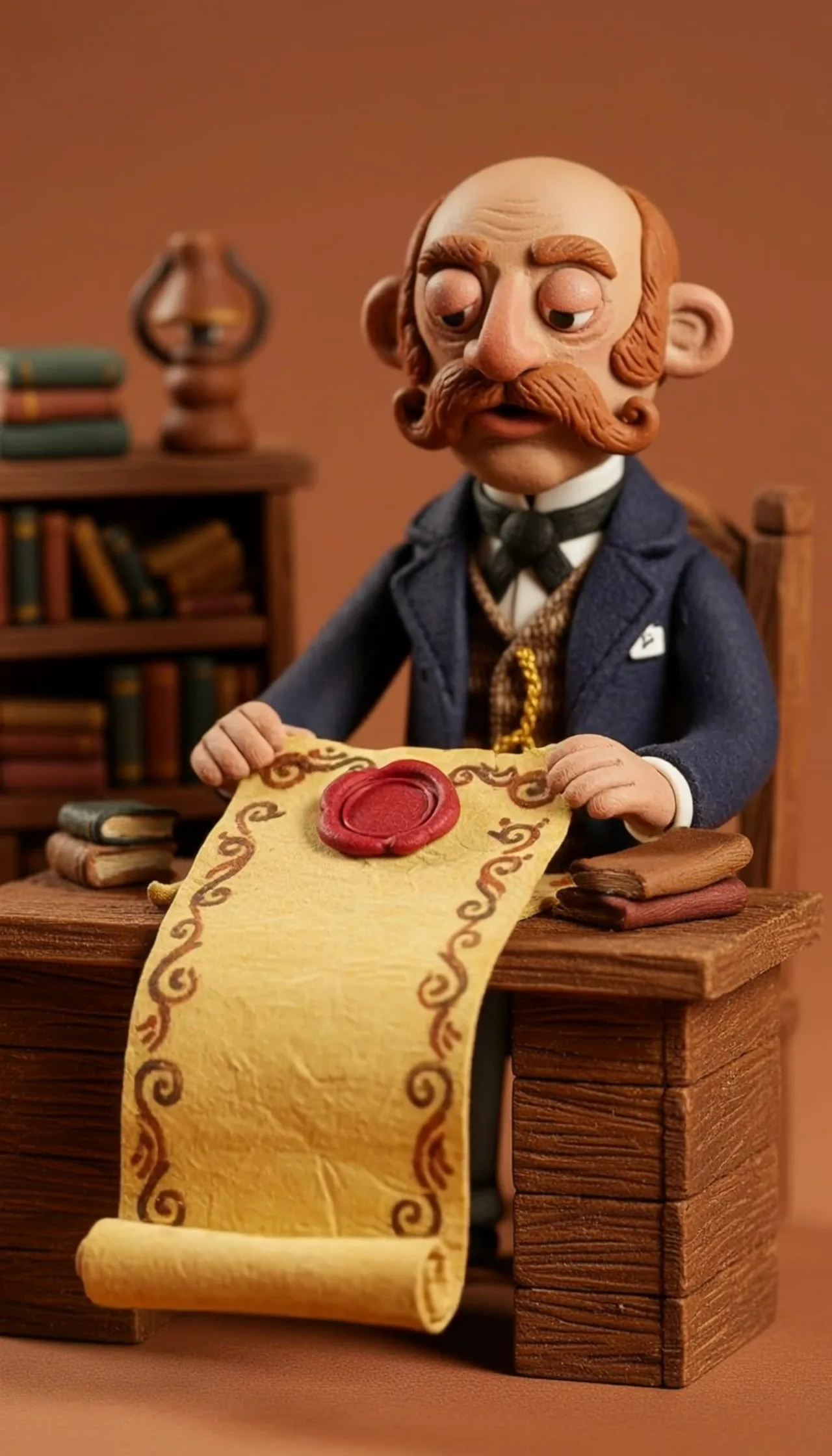
In the 1880s a former St. Louis real estate agent told the people of central Arizona that their land was his. His papers said a Spanish king had granted it long ago to a nobleman, and that the title had passed to James Addison Reavis. The Southern Pacific paid him. A silver mine paid him. It took the United States about a decade to prove that the papers were forgeries he had made and planted himself. This page tells the story from the government's own records and reputable history, then maps it to the checks a KYB analyst runs on documents today.
What really happened
The claim
Under the treaties that brought the Southwest into the United States, the government had to honor valid Spanish and Mexican land grants. Reavis built one. The Surveyor General of Arizona recorded that the claimed Peralta grant took in Phoenix, Florence, Tempe, Globe, Silver King, Casa Grande and other towns, along with producing mines. American Heritage reports that in Reavis's later, enlarged version the grant ran 75 miles deep by 225 wide.
The paper trail was elaborate: royal decrees, wills and codicils, genealogies of a nobleman he called the Baron of the Colorados, and deeds passing the grant through a prospector named George Willing to Reavis. He later married a young woman he presented as the grantee's last heir. American Heritage reports that he searched archives in Madrid and Seville and in Guadalajara, Mexico, and had notaries certify that his copies matched the originals filed there.
Who paid
The claim clouded every title inside its boundaries, and people paid to make that go away. American Heritage reports that Reavis charged the Southern Pacific $50,000 for having run its tracks across his land, and that the Silver King mine handed over $25,000 as an initial payment. Hired publicists and newspapers told settlers the title was ironclad and included water and mineral rights. Some paid for quitclaims. We could not verify from a source we fetched that settlers abandoned their homes, as the film shows.
How it came apart
The first official challenge came from inside the paperwork. In a report published in 1890, Surveyor General Royal A. Johnson rejected the grant as fraudulent. He found that writing on the key document, which was supposed to date from the 1700s, had been made with a steel pen, "impossible if the document was executed at the date it is alleged to have been", and he cited affidavits that one deed in the chain was a forgery.
Reavis answered by suing. His 1890 petition to the U.S. Court of Claims (No. 16,719) asked for six million dollars plus five million more, "in the aggregate eleven million dollars damages". American Heritage describes a $10,000,000 damage suit pressed in the Court of Private Land Claims in 1893; the figures differ between sources.
The suits forced a full investigation. American Heritage reports that "every copy which Reavis exhibited found recognition in a duly filed original", so the government sent agents, including document examiner William Tipton and lawyer Severo Mallet-Prevost, to the archives in Spain and Mexico. Their findings showed the documents had no genuine basis, and the Court of Private Land Claims ruled against the claim in 1895.
The film says one page had been slipped into an archive in Seville. Later histories describe an archivist there finding a document in a bundle where it had not been before; we could not check that detail against a primary source, so treat it as reported, not established.
The sentence
Reavis was convicted of conspiracy in 1896 and sentenced to two years in prison and a $5,000 fine, the figure most accounts give and the one the film uses. He was held from July 18, 1896 to April 18, 1898, which fits a two-year term shortened for good behaviour. One secondary account, American Heritage, calls it a six-year sentence; we did not find a primary court record for either figure. The Library of Congress gives his dates as 1843 to 1914. American Heritage says he was never again successful; we could not confirm from a primary source the film's line that he died a pauper.
The film
The Baron of Arizona is a one-minute claymation dramatization. Characters are clay figures, scenes are staged, and events spanning twenty years are compressed.
Narration transcript
He told Phoenix he owned it. The railroad paid him.
His name was James Reavis. His papers said a Spanish king had granted the land long ago: Phoenix, Tempe, a silver mine, the railroad tracks.
The Southern Pacific agreed to pay him fifty thousand dollars. The silver mine paid twenty-five thousand.
Settlers got notices telling them to pay. Some just packed up and left.
Where did the papers come from? He made them, and slipped them into old archives, so anyone who checked would find them.
Then he did the one thing a forger never should. He sued the United States for eleven million dollars.
So the government finally checked. Page by page.
The ink was wrong. One page had been slipped into an archive in Seville.
The Baron of Arizona got two years in prison. He died a pauper.
The papers were perfect. Nobody checked who brought them.
Today, the paperwork still looks perfect.
Sweat AI checks where it came from.
Ask who wrote the deed. Get Sweat AI.
How KYB would have caught it
Reavis beat every check that asked "does a matching record exist?" He lost to checks that asked where a record came from and whether it could be what it claimed to be. Those are the same questions an analyst asks of a certificate, statement or ownership chart.
| Red flag | What a KYB or fraud analyst checks | Evidence that would have surfaced |
|---|---|---|
| Title rests on documents the claimant supplied | Pull the record directly from the issuing registry or archive, not from the applicant's copy | Originals that appear only where the claimant had recently been searching |
| Certified copies used as proof | Treat a certification as "copy matches file", then check the file's own provenance: when it was lodged, by whom | A copy certified against an original that had itself been planted |
| Physical or format anomalies | Examine the document for features impossible at its stated date (templates, fonts, metadata, pen and ink) | Steel-pen writing on a document dated to the 1700s, as the Surveyor General found |
| Long ownership chain with gaps | Map each link of the chain to an independent record; ask for the missing link | A deed the named grantor's agent swore was forged |
| Heir or owner who appears only in the claimant's papers | Verify identity and relationship through independent civil records | Witnesses paid to support the heir's story, per American Heritage |
| Counterparties paying to avoid a dispute | Ask what verification the payer did before paying | A railroad and a mine paying on the strength of a claim no authority had confirmed |
Related terms
- Business verification documents
- Evidence packet
- Certificate of good standing
- Ultimate beneficial owner
- Guide: What a certificate of good standing proves in KYB
When the paperwork looks perfect
Most perfect paperwork is genuine, and checking it well means going past "a matching record exists" to where the record came from. Sweat AI is an AI-native BPO for banks and fintechs, and our analysts do this work on onboarding and fraud queues, nights and weekends included. We prepare the review, the evidence and a recommendation; your team makes the decision. See a finished file in our sample KYB review.
Questions
Who was the Baron of Arizona?
James Addison Reavis (1843 to 1914), who claimed title to a vast Spanish land grant covering much of central Arizona, including Phoenix, Tempe and Florence, through a chain of documents that turned out to be forged. The grant was rejected in 1895 and he was convicted in 1896 and sentenced to two years in prison.
How did Reavis make money from a land grant that was never confirmed?
By selling certainty. Settlers, mines and a railroad inside the claimed boundaries paid him for quitclaims or rights of way rather than risk litigation. American Heritage reports that the Southern Pacific paid $50,000 for the right to run its tracks across the claim and the Silver King mine paid $25,000 as an initial payment.
How were the forgeries exposed?
The Surveyor General of Arizona, Royal A. Johnson, reported (published 1890) that key papers were forged, noting for example writing made with a steel pen on a document said to predate usable steel pens. After Reavis sued the United States, government agents examined the Mexican and Spanish archives the documents came from, and the Court of Private Land Claims rejected the claim in 1895.
Is a notarized copy of an old document proof that the original is genuine?
No. A notary or archivist certifies that a copy matches a filed original. Reavis relied on exactly this: his copies matched originals he had placed in the archives himself. Provenance, meaning where a document came from and who put it there, has to be checked separately.
Sources
- James Reavis, Wikipedia (criminal penalty: $5,000 fine and 2 years' prison), accessed 2026-09-30
- Adverse Report of the Surveyor General of Arizona, Royal A. Johnson, upon the alleged Peralta Grant (1890), Internet Archive, accessed 2026-09-30
- J. A. Peralta Reavis et al. v. The United States, No. 16,719, Court of Claims: Petition of Claimants (1890), Internet Archive, accessed 2026-09-30
- American Heritage: The Prince of Swindlers, by John Myers Myers (August 1956), accessed 2026-09-30
- Library of Congress Name Authority File: Reavis, James Addison, 1843-1914, accessed 2026-09-30