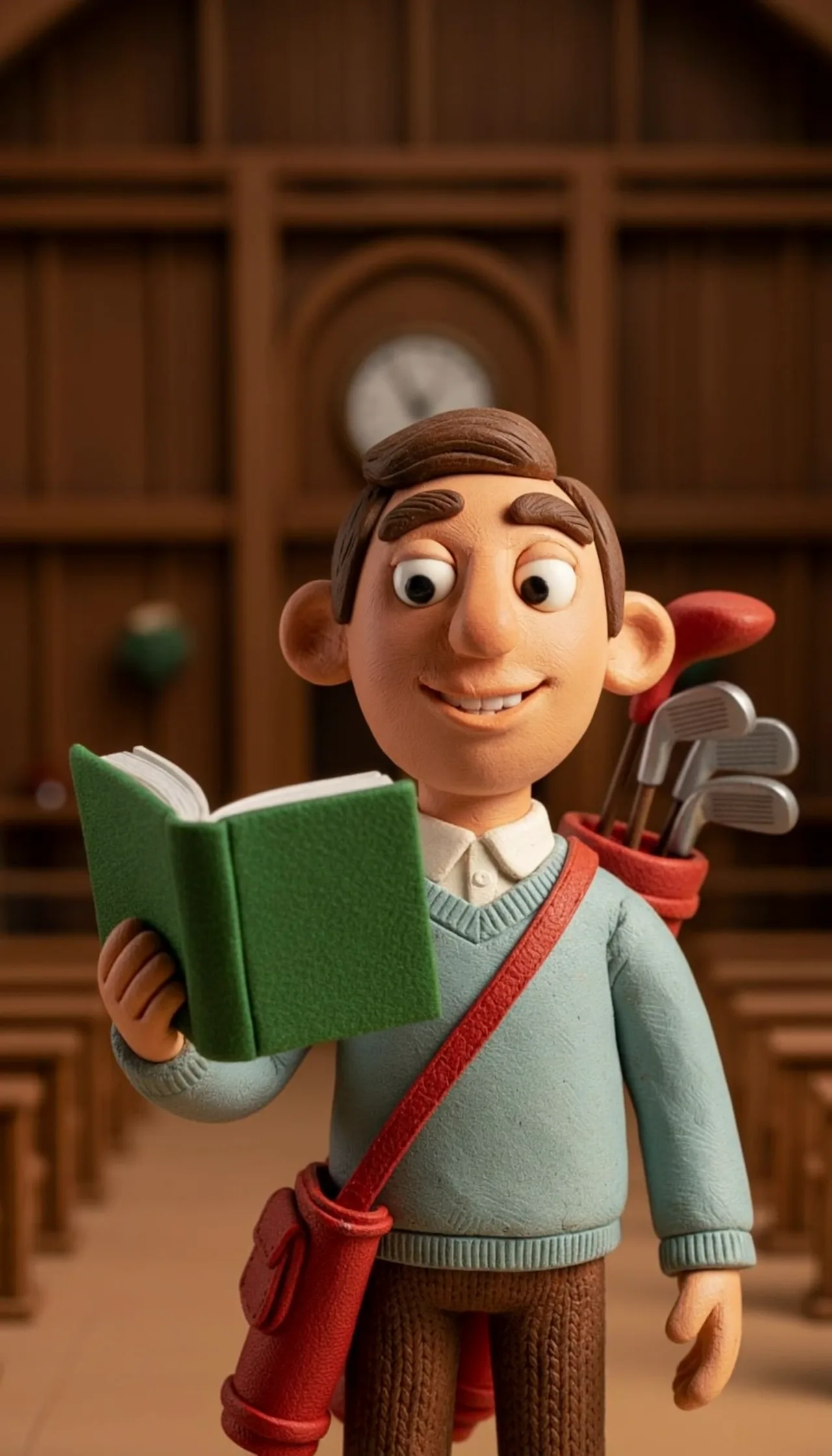
In 1976 a crane driver who had never played a full 18-hole round teed off in qualifying for the Open Championship. He got there by ticking one box on an entry form. Maurice Flitcroft was not a fraudster in the criminal sense: he paid his own entry fee and harmed nobody's savings. He is in this series because his story is the cleanest example of a problem every onboarding team knows: a self-declared status, accepted because the form allowed it, with nothing behind it.
What really happened
A late start
Flitcroft was born in Manchester in 1929. The Times obituary says he served in the Merchant Navy, worked as a stuntman and high diver in a touring comedy show, then moved to his wife's home town of Barrow-in-Furness and became a crane driver at the Vickers Armstrong shipyard.
The BBC reports that he took up golf in the autumn of 1974, aged 45, after watching a tournament on television. The Guardian's 2006 interview says he borrowed a Peter Alliss instruction book from the library, bought a half-set of mail-order clubs and practiced on the local beach, then moved to a school playing field because the beach was too windy. He sometimes hopped a course fence to hit a few shots, but never played 18 holes.
The entry form
Qualifying for the 1976 Open, held at Royal Birkdale, asked entrants to tick amateur or professional. "I couldn't enter as an amateur because I wasn't a member of a club and I didn't have a handicap certificate," Flitcroft told the BBC. "But I didn't need those things to enter as a professional. My entry was accepted and that was it." The Guardian puts the entry fee at £30.
He was sent to 36-hole qualifying at Formby. He got lost on the way and went straight to the first tee. His playing partners, professionals Jim Howard and Dave Roberts, sent for an R&A official after his second shot, but the BBC reports officials could not remove a player once he had started. He finished with 121, 49 over par, with a "12 with a question mark" on the par-five eighth after a player in the group behind said he saw at least that many shots in the dunes. The Guardian calls it the worst score in the tournament's history. His partners got their entry fees back, according to the Times. Flitcroft went home rather than play the second round.
Banned, then back under other names
The R&A banned him, and the Times says it tightened its entry rules. When he applied the next year, R&A secretary Keith Mackenzie turned him down because he had provided no proof his game had improved. The BBC says the R&A later hired a handwriting expert to spot his applications.
He kept trying. In 1984 he entered as Gerald Hoppy, a supposed Swiss professional, and lasted nine holes and 63 strokes before officials realized who he was (Guardian). In 1990 he entered as Gene Paycheki, a supposed American professional, and was stopped on the third hole at Ormskirk after officials recognized his son (Guardian). The BBC lists other entry names: James Beau Jolley, Arnold Palmtree and Count Manfred von Hoffmenstal. He died on March 24, 2007, aged 77. A 2011 biography and a 2022 film, both titled The Phantom of the Open, tell his story.
Where the film simplifies
- "Half a set of clubs." The Guardian says half-set. Jim Howard told the BBC there were 15 clubs in his bag at Formby and his caddie returned one to reach the legal 14. Flitcroft himself told the Guardian he left a fifteenth club, his four-wood, in the car.
- "A few swings in a field." He took up golf in autumn 1974 (BBC) and practised on a beach, then a school playing field, without ever playing 18 holes (Guardian).
- "On the entry form, he wrote one word: professional." He ticked a box.
- "In front of a silent crowd." Staged for the film; our sources do not describe the crowd.
- "The worst round in the history of the Open." It was qualifying for the Open, not the championship itself; 121 is described as the worst score in the tournament's history.
- "The golfer behind him snapped and yelled that this wasn't a circus." We found no source for this line.
- "Other players demanded their entry fees back." The Times says his partners got their fees back; we found no source for a demand.
- Spellings. Sources spell the aliases Paycheki, Pacheki and Paceky, and Gerald Hoppy; the film follows Wikipedia's Gerrard Hoppy.
The film
The Phantom of the Open is a 53-second claymation dramatization released on September 30, 2026. Characters are clay figures and scenes are staged.
Narration transcript
He entered the British Open with a library book and half a set of clubs.
His golf career so far: a few swings in a field. So on the entry form, he wrote one word: professional.
Nobody checked. Maurice Flitcroft, a shipyard crane operator, practised on a beach.
In 1976, in front of a silent crowd, he teed off.
He shot one hundred and twenty-one. Forty-nine over par. The worst round in the history of the Open.
The golfer behind him snapped and yelled that this wasn't a circus. Other players demanded their entry fees back.
He was banned for life. So he came back in disguise.
He came back as Gene Paycheki. As Gerrard Hoppy. As James Beau Jolley.
One form. One word. Nobody checked the man.
Sweat AI checks who's really behind the application.
Watch the swing. Get Sweat AI.
How KYB would have caught it
Business onboarding has the same weak point as the 1976 entry form: a self-declared category that unlocks a lighter path. An applicant who says "professional" skips the handicap check; a business that describes itself as low risk can skip the questions a higher-risk business would get.
| Red flag | What a KYB or fraud analyst checks | Evidence that would have surfaced |
|---|---|---|
| A self-selected category that removes a requirement | Ask what evidence supports the declared category and whether it can be confirmed from a source the applicant does not control | No professional body membership or tournament record behind "professional" |
| Stated standing with no history | Check the claimed track record against independent records: registry filing history, prior activity, references | No club membership, no handicap, no recorded competitive rounds |
| A new identity with a familiar pattern | Compare new applications against prior declines on stable identifiers: address, contact details, related persons, handwriting or device | His handwriting, which the R&A hired an expert to spot, and a son officials had seen before |
| Names that do not resolve to a real person | Match each name to an identity document and an independent record | "Gerald Hoppy of Switzerland" and "Gene Paycheki of the US" with no documents behind them |
| A declined applicant reapplying | Record the reason for a decline and flag reapplications for review rather than fresh intake | A prior ban and correspondence on file |
The R&A eventually did most of this: it required proof of improvement, watched for his handwriting and recognized his son. Each check came after an entry had already been accepted.
Related terms
- Business verification documents
- Business onboarding review
- High-risk business categories
- Request for information (RFI)
- Four-eyes review
- Guide: How to verify a business for KYB
When the application looks like this
Most applicants who tick a box are telling the truth. The work is confirming the claim behind the box before it unlocks anything. Sweat AI is an AI-native BPO for banks and fintechs, and our analysts do this on onboarding queues, nights and weekends included. We prepare the review, the evidence and a recommendation; your team makes the decision. See a finished file in our sample KYB review.
Questions
Who was Maurice Flitcroft?
A crane driver from Barrow-in-Furness, born in Manchester in 1929, who entered qualifying for the 1976 Open Championship as a professional after about 18 months of playing golf. He shot 121, 49 over par, the worst score in the championship's history. He died in March 2007, aged 77.
How did he get into the Open?
The entry form asked applicants to tick amateur or professional. Amateurs needed a club membership and a handicap certificate, which he did not have. Professionals did not need either, so he ticked professional and his entry was accepted.
What names did he use after he was banned?
Reports list Gerald Hoppy, a supposed Swiss professional, in 1984; Gene Paycheki (also spelled Pacheki), a supposed American professional, in 1990; and entries as James Beau Jolley, Arnold Palmtree and Count Manfred von Hoffmenstal.
Was Maurice Flitcroft a fraudster?
He was not convicted of anything and took no one's money beyond entry fees he paid himself. His case belongs in this series because it shows a self-declared status accepted without verification, which is the same gap that lets false business applications through.
Sources
- The Times: Maurice Flitcroft, obituary (March 28, 2007), archived copy, accessed 2026-09-30
- BBC Sport: 'Phantom of the Open': How Maurice Flitcroft tricked the R&A (July 14, 2022), accessed 2026-09-30
- The Guardian: Flitcroft runs out of steam and names in his long-running tilt at windmill (July 17, 2006), accessed 2026-09-30